Mechanically Stabilized Earth (MSE) retaining walls typically consist of special backfill soil reinforced with either steel strips, steel bar mat, or polymeric materials. The reinforcement is attached to the retaining wall (panels) to provide stability of the MSE structure. On top of the retaining wall and the backfill soil, a barrier–moment slab subsystem is installed. A crash wall constructed of reinforced concrete can be cast against the MSE wall panels with steel anchors embedded between the crash wall and the MSE panels.
The use of geosynthetics within mechanically stabilized earth walls and reinforced soil slopes allow for vertical grade changes along highways and at building sites at substantially less cost than conventional retaining walls. Conventional retaining walls are gravity structures which must be massive enough to resist the destabilizing forces of the retained fill. Reinforced soil walls create gravity retaining structures out of the fill itself by incorporating geosynthetic reinforcement into the design.
The idea of incorporating layers of elements to reinforce soil has been around for years and can be seen in use today within highway alignments, building sites, and residential communities. Our mechanically stabilized earth (MSE) systems are based on this “reinforced soil” concept. MSE systems significantly strengthen the soil and allow the construction of slopes angled at varying degrees. Whatever the slope angle your project requires, our MSE systems are designed to address your needs.
Benefits of MSE Walls Slopes
- Cost-effective construction technique
- Improved soil shear resistance
- Improved performance of on-site soils
- Minimization of land acquisition
- Reduced construction time

 MSE Walls Slopes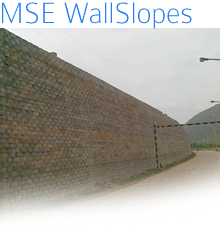

 Copyright © 2012 GeoSol Associates. All rights reserved. | Powered By